How Three Women in a Lagos Compound Gave Me Back Something I Thought I Had Lost Forever After My Second Baby

"If you haven't felt like yourself since your last baby — this is for you."
If you have been quietly suffering since your last baby — if sex feels wrong, painful, dry, or like something you simply endure — read every word on this page.
If you lie there some nights and feel nothing. Not desire. Not connection. Just absence.
If you have started to wonder whether this is just what marriage becomes after children.
If your husband hasn't said anything — but his silence is getting louder every week.
Read this. Because what I am about to share changed everything for me.
You tried different things. You asked around quietly. You searched at midnight when the baby was finally asleep. You found advice written for women in other countries, with other lives, other bodies. Nothing that sounded like you.
Everyone said rest. Like rest alone was going to fix the fact that your husband reaches for you and your body just... doesn't respond.
Time passed. Nothing came back.
You started performing. Going through the motions. Telling yourself it's fine. It's temporary. It'll come back on its own.
But deep inside — you know something is missing. And you don't know who to ask. Because this is not the kind of thing Nigerian women discuss. Not with your mother. Not even with your closest friends.
So you carry it alone.
And the longer you carry it, the heavier it gets. Because it's not just about sex. You know that. It's about the distance growing between you and your husband. The conversations that used to happen but don't anymore. The feeling that you are slowly becoming strangers in the same house.
You catch him quiet sometimes. And you wonder.
You wonder how long he will wait. You wonder what he's thinking. You wonder if he's already looking elsewhere. And that fear — that fear alone — is exhausting in a way that nobody talks about.
This is the real cost of what's happening to you. Not just the dryness. Not just the disconnection. The fear of what it means for your marriage.
"I know. Because I carried it too. For longer than I want to admit. Until one evening in a compound in Surulere — three women gave me back something I didn't even know how to ask for."
My name is S.O.O.L.
I am not a doctor. Not a nurse. Not a therapist. I am a woman who spent a long time inside this exact problem — and came out the other side with something I want to give every Nigerian woman who is suffering in silence right now.
I had my second baby and everything changed.
Not loudly. Not with drama. Just quietly. The way water goes cold when you're not paying attention.
My husband was still there. Still good to me. Still present. But something between us had gone still. And I could feel him feeling it too — even when neither of us was saying anything.
I tried things. Different things. Things people suggested. Things I found online at midnight when the baby was finally asleep. And everything I found was written for women in other countries, with other bodies, other lives. Nothing that sounded like me. Nothing that knew what a Nigerian woman in a Lagos marriage actually goes through.
Nobody told me this was normal. Nobody told me there was a name for it, a reason for it — and most importantly — a solution for it that my grandmothers already knew.
I found that solution in the most unexpected place.
A compound in Surulere. Three women. One ordinary evening.
Lagos is the kind of place where you can disappear even when you're surrounded by people.

But a compound — the old kind, with shared corridors and a small courtyard where the women gather on weekends when they wash and clean, or on the occasional free evening when Lagos allows it — that's different. In a compound, you cannot hide for long. The women notice when your washing hasn't been hung. When your light went off too early. When your laughter has been absent for too long.
She had been absent for a long time.
Not physically. I was there every day. Cooking, carrying the baby, managing everything. Being a wife, being a mother, doing everything right on the outside.
But the women in my compound — my Yoruba neighbour, my Igbo friend two doors down, my Hausa-Fulani neighbour who didn't talk plenty but when she talked, ehn, you listened — they noticed.
One evening I came out to sit in the compound. I hadn't planned to. I just needed air. They were already there, gisting the way Lagos women gist — loud and warm and full of life. And then my Yoruba neighbour looked at me. Really looked at me. The kind of look that sees through the wrapper you've tied too tightly over everything.
She said:
"How body, hope everything dey okay? This one wey you dey carry face up all the time."
I tried to laugh it off. "I'm fine. Just tired. New baby na."
My Igbo friend shook her head slowly.
"This one pass tired o. Na something else."
And that was it. I just stopped pretending.
Before I could finish my sentence, my Yoruba neighbour was already nodding. Like she had heard this story before. Like she had lived it herself.
"Every woman wey born pikin don pass this road. The problem is nobody tells you before you reach there."
My Igbo friend leaned forward and started talking. About how their mothers were never rushed back into the bedroom. About how there was a whole protected period where a woman was allowed to heal completely — her body, her mind, her sense of herself — before anything was expected of her. About how rest was not laziness. It was medicine. About how reconnecting with your own body first, before your husband, was not selfishness. It was wisdom.
I had never heard it said like that before. I had never been given that kind of permission before.
And then my Hausa-Fulani neighbour stood up quietly.
Went inside.
Came back out.
Placed something in my hand.
"Use this. Every Fulani bride knows this. Every woman who has given birth in our household has used this. It is not new — it is just forgotten by your generation. Don't ask me plenty questions — just be consistent. Thank me in two weeks."
That was all. No long explanation. No grammar. Just the kind of confidence that only comes from something that has worked for generations.
I went home that night with three things I didn't have before.
Something to do for my body — from my Hausa-Fulani neighbour.
Something to understand about myself — from my Igbo friend.
Something to remember about who I was before the baby — from my Yoruba neighbour.
What Those Three Women Knew That Nobody Told You
The thing is — what happened to me after my second baby is not unusual. It happens to almost every woman who gives birth. The dryness. The disconnection. The quiet death of desire.
But here is what your grandmother knew and what nobody has told you:
Your body did not break. It was never given the right conditions to restore itself.
After childbirth, your body goes into a different mode entirely. It is busy. It is doing important work. And in that busyness, it puts certain things on hold — desire, natural lubrication, warmth, the feeling of being alive inside your own skin.
This is not permanent. This is not who you are now. This is your body waiting for the right signal. The right nourishment. The right practices. The right knowledge.
Your grandmothers had that knowledge. It was passed from mother to daughter, from compound to compound, from tribe to tribe. What the Yoruba woman knew. What the Igbo woman practiced. What the Hausa-Fulani woman kept in a small bottle and placed in a younger woman's hand without explaining too much — because some things just work, and they have always worked.
The knowledge didn't disappear. It just wasn't passed to you. Until now.
"It is not gone. It is waiting. Your body has always known how to return — it just needs the right conditions."
The First Few Days: Nothing
I will not lie to you.
Day 1 — nothing. I didn't expect fireworks but I expected something. There was nothing.
Day 2 — nothing. I almost felt silly. Three women in a compound and I believed them like that?
Day 3 — nothing obvious. But I slept deeper that night than I had in months. I noticed that.
Day 4 — I almost stopped. My husband came to bed and I felt that familiar bracing. That tensing. I remember thinking — this isn't working.
But I remembered what my Yoruba neighbour said: "Every woman wey born pikin don pass this road." They had all been here. They had all continued anyway. So I continued.
Day 5: The First Sign
Something was different. I couldn't explain it exactly.
Not dramatic. Not obvious. Just — different. Like a room that had been cold for a long time and you suddenly notice it's a little warmer. You didn't feel it change. You just notice it has.
I didn't say anything to my husband. I just noticed.
Day 6. Day 7. Then Something Broke Open.
By Day 7, the warmth wasn't something I had to look for. It was just there.
By Day 8 — and this is the detail that still gets me when I think about it — I forgot to check.
For so long, I had woken up every single morning already carrying it. Already bracing for the day. Already aware of what was missing, what wasn't working, what I couldn't give my husband.
And then one morning I woke up and I had simply... not thought about it.
"I forgot to check. After all that time waking up inside that fear every single morning — I forgot. That forgetting was the proof."
But the real test was yet to come.
Friday Night
My husband reached for me.
I didn't move away.
That sounds like a small thing. It was not a small thing. For all that time, every time he reached for me there was a flinch — not always visible, but always there. A preparation. A performance. A quiet apology in my body for what I couldn't give him.
That Friday night there was none of that.
There was just me. Present. Warm. There.
Afterward he held me and didn't say anything for a long time. And then he said quietly — "I missed you."
He didn't mean that night. He meant all of it. The whole time. He had felt it too. The absence. The person-shaped space where his wife used to be.
"He held me like I had come back from somewhere very far away. Because I had."
I cried. Not from sadness. The other kind of crying — the kind that happens when something you thought was lost finds its way back to you.
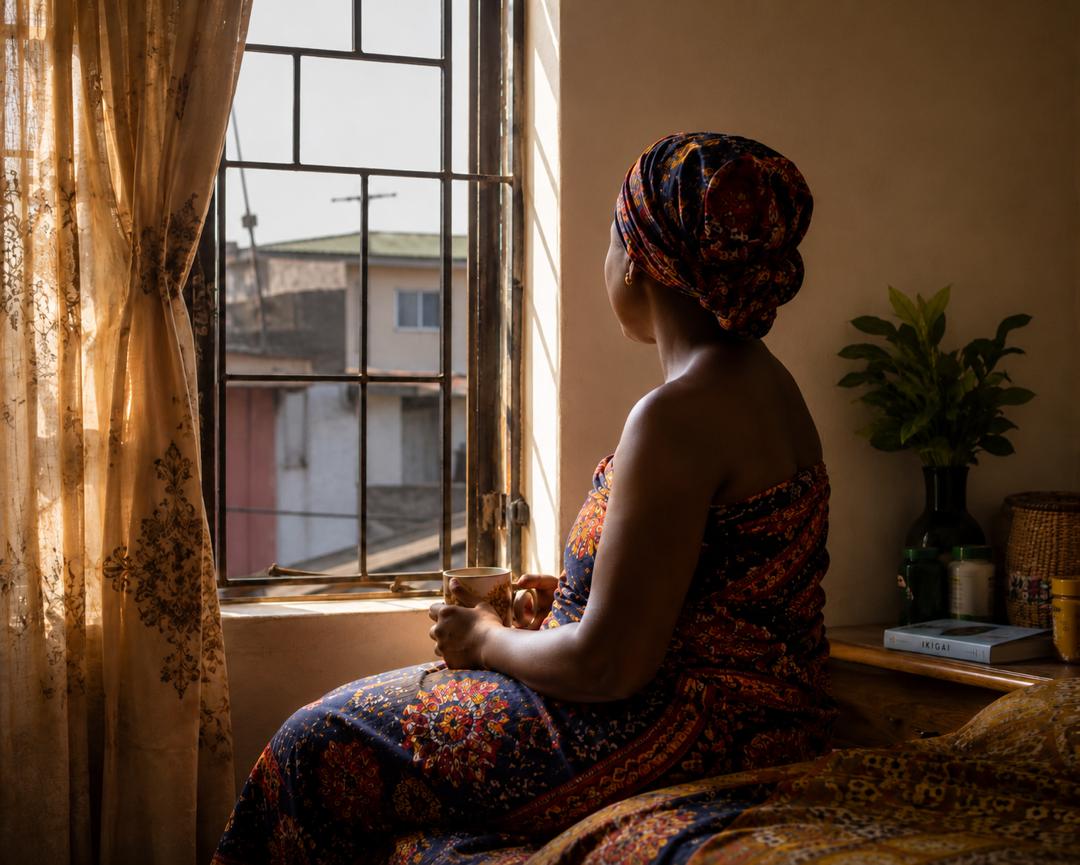
I Didn't Plan to Tell Anyone
I told one friend. Just one.
She went quiet on the phone for a moment and then said — "How long have you had this? Because I have been carrying the same thing for eight months and I didn't know who to ask."
She tried it. She called me twelve days later.
From there it spread the way things spread between Nigerian women — quietly, urgently, through voice notes and WhatsApp messages and whispered conversations at naming ceremonies and family gatherings.
Woman to woman. The way it was always supposed to be shared.
Here is what some of them told me:
"I had my third baby and honestly I thought that part of my life was just finished. My husband was patient but I could see it was taking a toll on him. I started this method because my friend sent it to me. By the second week I was the one reaching for him. He didn't know what changed. I didn't explain. I just came back."
"I had been carrying this quietly for so long I started to believe it was just my new normal. This method — I followed it for 30 days. The difference is not something I can fully explain in words. My body feels like mine again. That is the only way I know how to say it."
"After my first baby I was fine. After the second one something shifted and it never came back — for almost two years. Two years! I thought this was just how things were now. My sister sent me this guide. I want to cry when I think about how long I carried that thing alone when the solution was right there in our own tradition."
"My husband actually noticed before I told him anything. He said 'you seem different — good different.' I hadn't said a word to him about what I was doing. That told me everything I needed to know."
"I am in the UK. I was scared some of the ingredients would be hard to find here. Everything was available in the African shop on my street. I didn't have to go anywhere special. I followed the method. It worked. Simple."
"What I love about this is that it doesn't feel like medicine. It feels like being taken care of. Like the aunties came back. Like someone finally sat down with me and said — here, this is what you need. I felt seen in a way I haven't felt since before I had children."
Same method. Same wisdom. Same results.
Why I Am Sharing This
I went back to my Hausa-Fulani neighbour. Told her what happened.
She laughed. The quiet, knowing kind of laugh that older women have when something goes exactly the way they knew it would.
I told her I wanted to write it down. Document everything — the Yoruba wisdom, the Igbo practices, the remedy she had given me. Put it together in one place so that other women didn't have to wait to stumble into a compound and find the right three neighbours.
She was quiet for a moment. Then she said:
"Do it. Write it down. But make sure they follow it exactly — no shortcuts. And make sure they understand — they were never broken. They were just never shown."

Everything those three women taught me — documented, structured, written in plain honest language so you can begin tonight. No travelling anywhere. No needing the right neighbours. The knowledge comes to you.
Here is exactly what is inside:
- The Three Mothers Method (Phase One — Restore) — The complete Yoruba postpartum restoration system. Herbal steam baths, abdominal binding, restorative eating and protected rest — exactly what to do, in what order, every day for the first 10 days. (Pages 12–28)
- The Traditional Wetness Remedy — The exact remedy my Hausa-Fulani neighbour placed in my hand. Step-by-step preparation instructions, how to take it, what to expect and when. Including what to do if you cannot find every ingredient. (Pages 19–24)
- Phase Two — Reconnect (Days 11–20) — Igbo wisdom for rebuilding your relationship with your own body, desire and identity beyond motherhood. The practices that make intimacy possible again — before you bring your husband into it. (Pages 29–44)
- Phase Three — Return (Days 21–30) — How to ease back into intimacy on your terms. Practical guidance for the return to sex including what to expect, what to do if there is discomfort, and how to make it genuinely good again — not something you endure. (Pages 45–58)
- The #1 Mistake That Keeps Women Stuck — The single thing most women do that undoes all the progress they've made — and how to avoid it. (Page 17)
- Restorative Foods & What to Avoid — A complete list of what to eat, what to reduce and why — drawn from all three traditions. Ingredients available in any Nigerian market or African grocery store worldwide. (Pages 25–27)
- The Partner Conversation — Exactly what your husband needs to understand — and the words to say it. Because a husband who understands becomes your greatest support. A husband who doesn't becomes unintentional pressure that slows everything down. (Pages 59–68)
- The Extended Protocol — For women whose journey needs more time. A gentle continuation plan for those who need beyond 30 days — without shame, without pressure. (Pages 69–72)
You do not need to travel anywhere. You do not need a special doctor or a specific market. Everything in this guide is available in your local market, your nearest African grocery store, or your own kitchen. Total cost of materials? Less than ₦5,000.
What This Knowledge Is Actually Worth
Think about what your grandmothers had that you don't.
They had time. They had community. They had women around them who had walked this road before and knew exactly what to do. Women who didn't have to Google anything — because the knowledge lived in their hands, their kitchens, their compounds.
That knowledge was never cheap. It was priceless. It was the difference between a woman who healed completely and a woman who spent years wondering why she never felt quite like herself again.
The knowledge in this guide took generations to build. Yoruba women carried their part of it. Igbo women carried their part. Hausa and Fulani women carried theirs. It was tested across hundreds of years, passed from mother to daughter, refined and trusted because it worked — not because someone put it in a bottle and sold it, but because real women used it and real women healed.
What you are getting today is not a product. It is not a quick fix. It is that knowledge — documented, structured and placed in your hands so that the village your grandmother had finds its way to you, wherever you are in the world.
That is what ₦6,500 buys you today. Not a promise. Not a theory. Ancestral wisdom that was always meant to reach you.
How Much Does This Guide Cost?
Let me be transparent with you about what went into creating this.
Research and documentation of traditional practices across three Nigerian ethnic traditions — ₦45,000
Professional writing and editing — ₦60,000
Cultural verification with traditional knowledge holders — ₦30,000
Design and layout — ₦25,000
Digital platform and delivery setup — ₦15,000
Total investment to create this guide: over ₦175,000.
A fair price for this guide would be ₦15,000. That is still less than one pharmacy visit and two rounds of supplements that didn't work.
But I know times are hard. And I know that the women who need this most are often the ones counting every naira. So if you take action today —
Once You Click That Button, Here Is What Happens
- You are taken directly to a secure payment page. Simple, fast, private.
- You complete your payment — card, transfer, or mobile payment.
- Your guide is delivered to your WhatsApp AND your email within 60 to 90 seconds. No waiting. No following up. It arrives immediately.
It is me, S.O.O.L. As long as your payment is confirmed, your access is 100% guaranteed — delivered to your phone within 90 seconds.
What Happens in the First 7–14 Days
Real conversations. Real women. Real results.
WAIT — I Have Something Special For You…
If you are one of the first 100 women to order today, you receive this at no extra cost:
Your complete daily checklist for all three phases — Restore, Reconnect and Return. Tick off each practice every day, track your progress week by week and write your reflections at the end of each phase. Print it or use it on your phone. Keeps you accountable, keeps you on track, keeps you moving forward even on the hard days.
Everything You Are Getting Today
- The Sex Reset Method — Complete 30-Day Guide
₦15,000 - BONUS: The 30-Day Sex Reset Tracker
₦3,500
Right Now, You Have Two Choices
Do Nothing
- The dryness continues. The disconnection grows.
- Your husband feels it. The silence between you gets louder.
- You keep performing instead of being present.
- You spend more money on things that don't address the real problem.
- Another year passes and nothing has changed.
Choose Yourself
- You follow a method rooted in centuries of Nigerian women's wisdom.
- By Day 5, something begins to shift.
- By Day 14, your husband notices before you say a word.
- By Day 30, you feel warm in your own body again.
- You come back. To yourself. To your marriage. To the life you deserve.
One-time payment. Instant delivery to WhatsApp and email.
💬 Did It Work For You?
If this method works for you — and we believe it will — we want to hear from you. Send us an email at underthewrapper@gmail.com with the subject line "It Worked" and tell us your experience. Your story could be the thing that helps another woman finally take the step she has been afraid to take.
One Last Thing…
Picture yourself one month from today.
Will you wake up feeling warm in your own body — not bracing, not dreading, just present?
Will your husband reach for you and find you there — actually there, not performing, not enduring?
Will you look in the mirror and recognise the woman looking back?
Will you feel like the distance between you and your husband has closed — not because you forced it, but because you finally gave your body what it needed?
Will you be the woman who sent this to her friend and said — this changed everything for me?
Now picture yourself one month from today if you close this page.
Everything stays the same. The silence. The distance. The performing. The fear.
"The difference between those two versions of you is a decision you make in the next sixty seconds."
I CHOOSE MYSELF — GET ACCESS NOWIf you have read this far and you are still hesitating —
Ask yourself honestly: what is the hesitation really about?
It is not the money. ₦6,500 is less than one evening out. Less than one outing with the children. Less than what you spend without thinking on things that bring you far less back.
The hesitation is something else. It is the part of you that has been carrying this so long, you've started to believe you don't deserve to put it down.
You do.
Your marriage deserves it. Your body deserves it. The woman you were before the baby — she deserves to come back.
If you cannot invest ₦6,500 in your own restoration, how do you expect your husband to keep investing in a marriage where you have disappeared?
Stop hesitating. Choose yourself.
YES — I CHOOSE MYSELFP.S. — If this method works for you — and we believe it will — send us an email at underthewrapper@gmail.com with the subject line "It Worked." Your story could change another woman's life.
P.P.S. — The ₦6,500 price is only available for the first 100 women. Once those slots are gone, the price returns to ₦15,000. Don't come back tomorrow and find it gone.
P.P.P.S. — Every day you wait is another day of performing instead of being present. Another day of that distance growing between you and your husband. Another day of not being fully in your own life. It doesn't have to be that way. Not anymore.
With love for your healing,
Frequently Asked Questions
How is the guide delivered?
Immediately after your payment is confirmed, the guide is sent directly to your WhatsApp number AND your email address. Delivery takes between 60 and 90 seconds. You do not need to wait, follow up, or chase anyone. It arrives on its own.
Are the ingredients easy to find? What if I live abroad?
Every ingredient used in The Sex Reset Method is available in Nigerian markets and in African grocery stores worldwide — including in the UK, USA, Canada, Australia and across Europe. The guide also includes alternatives for every ingredient so that if you cannot find something specific, you can still follow the method completely. Women in London, Houston, Toronto and Melbourne have all found everything they needed nearby.
What if my case has been going on for a long time — more than a year?
The Three Mothers Method works regardless of how long you have been experiencing this. Whether your baby is 3 months old or 3 years old — whether this has been going on for months or years — your body can still restore. The guide includes an extended protocol specifically for women who need more than 30 days, with no pressure and no shame attached.
What if my husband is skeptical or not supportive?
The guide includes a complete partner conversation chapter — exactly what your husband needs to understand and the words to say it. Many women find that once their husband understands what is actually happening, he becomes their greatest support. The chapter is written specifically for Nigerian men and can be shared directly with him. You can also begin Phases One and Two completely on your own — his involvement only becomes important in Phase Three.
What if I want to share my experience after using the guide?
We would love to hear from you. If the method works for you, send us an email at underthewrapper@gmail.com with the subject line "It Worked" and tell us your story. Your experience could be exactly what another woman needs to hear to finally take the step she has been putting off. Every testimonial we receive helps another woman find her way back to herself.
Why is this different from everything else I have already tried?
Most things women try after childbirth deal with what is visible on the surface. But what happened to your body goes deeper than the surface. The Sex Reset Method works from the inside out — restoring warmth, nourishment and desire the way Nigerian women have always restored them. Through food. Through ritual. Through deliberate, consistent care rooted in three cultural traditions that were designed specifically for this season of a woman's life. That is why the results last — because this method was built for exactly what you are going through.
© 2025 UnderTheWrapper | Privacy Policy | Contact
This guide shares traditional wellness practices rooted in Nigerian cultural heritage. It does not replace professional medical advice. If you have specific health concerns, please consult your doctor alongside using this guide.
Comments (847)
This article described my life so accurately I had to stop reading and breathe. The part about carrying it alone — that's me. That has been me for eleven months. Just ordered.
♥ Like (34)On Day 14 now. The WhatsApp testimonials sounded too good to be true to me but I bought it anyway. Now I understand. It's not magic — it's just the right thing, done consistently. My body is responding. My husband has been kinder this week than he's been in months. These things are connected.
♥ Like (61)I completed all 30 days. I want to leave this comment for the women who are still hesitating. Stop hesitating. The price is nothing compared to what you're losing every single day you don't have this information. I wish someone had given this to me three years ago.
♥ Like (112)I showed my husband the partner conversation chapter. He read it quietly, then he came and sat next to me and said "I didn't know it was this hard for you. I'm sorry." We haven't talked like that in a long time. The guide did more than restore my body. It opened a door between us.
♥ Like (89)I was in Canada when I found this. So happy it works for diaspora women too. Ingredients available at the African store nearby. Delivery was instant. Started that same night.
♥ Like (47)The story at the beginning had me in tears. I felt like she was describing my compound. My evenings. My silence. Reading this felt like finally being seen after a very long time of being invisible even to myself.
♥ Like (73)Leave a Comment